How to make a brand video without an agency
A lean in-house process for producing a polished brand video: brief, script, visual system, feedback, rights and delivery.
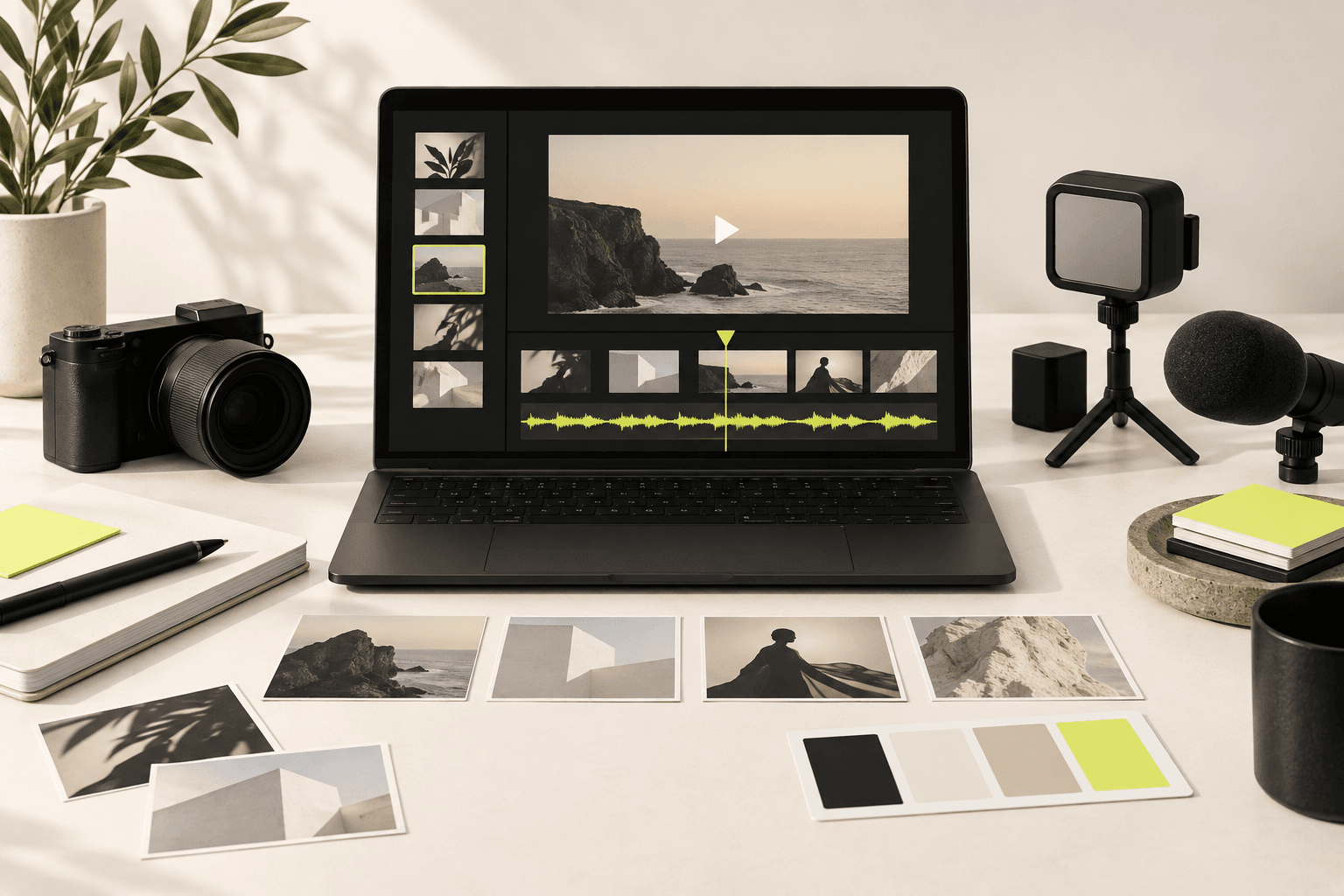
Making a brand video in-house is not mainly a software problem. It is a decision problem. Agencies provide a process for narrowing possibilities, assigning ownership and keeping feedback coherent. Recreate those functions and a small team can produce strong work without a large production structure.
Start with a one-page creative brief
- Audience: one primary viewer, described by situation rather than demographics.
- Change: what they should understand, feel and do after watching.
- Single message: the one sentence the film must make believable.
- Proof: product behaviour, customer evidence or a concrete fact.
- Constraints: duration, placements, deadline, available assets and approver.
Name one decision owner before writing. Invite specialists to check accuracy, but do not turn every preference into a vote. The fastest way to make an expensive-looking film feel cheap is to combine six incompatible opinions.
Write a script that survives without visuals
Use a simple arc: recognisable tension, a different possibility, the mechanism that makes it real, proof and one action. Read it aloud at normal pace. Cut any sentence that repeats the previous one, claims a benefit without evidence or could appear in a competitor's film.
Build a small visual system
| Decision | Lean default | Why |
|---|---|---|
| Type | One family, two weights | Creates hierarchy without visual noise |
| Colour | Brand neutral plus one accent | Keeps attention on the message |
| Motion | Two or three repeated behaviours | Makes scenes feel related |
| Sound | One licensed track plus restrained effects | Supports pace without becoming the idea |
Storyboard before polishing
Make rough frames with real copy and approximate timing. A storyboard exposes structural problems while changes are cheap. Review whether every scene communicates one idea, whether the product appears at the right moment and whether the final action follows naturally from the opening promise.
Run feedback in two passes
- Pass one: structure
- Review the claim, order, missing proof and duration. Ignore tiny visual details.
- Pass two: finish
- After structure is locked, review typography, motion, audio, captions and exports.
Ask reviewers to identify the problem and desired outcome, not prescribe a transition. Consolidate comments in one place, resolve contradictions with the decision owner and label the approved script before final rendering.
Protect the unglamorous parts
Confirm licences for music, footage, fonts and customer marks. Check factual claims and dates. Export captioned and clean masters, archive source files, and document the aspect ratios. These details determine whether the film can actually be reused six months later.
Set up your brand onceUse Frame24 to keep colours, type and visual rules consistent across every generated cut.